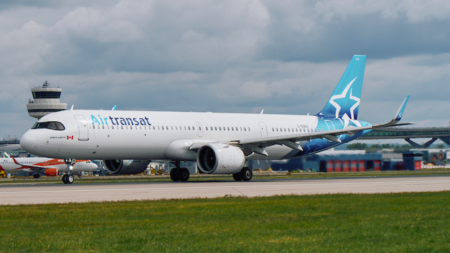
Air Transat (TS) has long carved a unique niche in Canada’s airline market. Unlike Air Canada or WestJet, which balance corporate and leisure demand, Air Transat has stayed true to its roots as a leisure-focused airline. Its business model leans heavily on international flights linking Canada with Europe, the Caribbean, and sun destinations. Domestically, its network is minimal, with only two scheduled routes.
In 2025, Air Transat’s busiest route overall is Paris–Montreal, with more than 133 million available seat miles (ASMs) over 113 monthly flights. This connection reflects the airline’s long-standing strength between Quebec and France, a market boosted not only by tourism but also by cultural and family ties.
By contrast, its busiest domestic link between Montreal and Toronto is modest in size, with 125 monthly flights but significantly fewer ASMs than the long-haul network.

Domestic Routes: A Small Footprint
Air Transat operates only two scheduled domestic routes, both linking Quebec with major Canadian hubs.
- Montreal–Toronto (125 flights, 27,223 seats, 8.6 million ASMs)
This is the airline’s primary domestic service, functioning as a connecting bridge for international passengers and a leisure-oriented alternative to the intense competition between Air Canada (AC) and WestJet on the same corridor. While Toronto–Montreal is one of the busiest city pairs in North America, Transat’s share is relatively small, with its schedule designed around feeding international departures rather than point-to-point business travel. - Quebec City–Montreal (31 flights, 6,431 seats, 932,495 ASMs)
This secondary domestic service is much thinner, operating with limited frequency. It caters mainly to Quebec-based passengers who would otherwise need to travel overland to Montreal for international departures. Its role is less about competing domestically and more about funneling passengers into Transat’s long-haul network.
These two routes show how Air Transat’s domestic operations are strategically minimal, serving as feeders rather than profit centers.

Busiest International Routes by Flights
When looking at flights operated, Air Transat’s busiest international routes are unsurprisingly to Europe, with some Caribbean routes also making the list.
- Paris–Montreal tops the chart with 113 flights a month, confirming its position as the backbone of Transat’s network.
- London Gatwick (LGW)–Toronto (87 flights) comes next, feeding Canada’s second-largest hub and connecting British leisure travelers with Canadian destinations.
- Routes like Rome–Montreal (60 flights) and Dublin–Toronto (60 flights) highlight how Transat balances southern European holiday markets with northern European cultural links.
- Caribbean destinations such as Cancún–Toronto (60 flights) and Punta Cana–Toronto (60 flights) highlight the focus on sun markets, especially in winter schedules.

Busiest International Routes by Seats
By total seats offered, Paris–Montreal again leads comfortably, with 38,654 monthly seats, far ahead of any other market. The next largest is London Gatwick–Toronto, with 26,942 seats, showing how the UK remains a core part of Transat’s Europe strategy.
High-capacity routes also include:
- Rome–Toronto (20,661 seats), boosted by the popularity of Italy among Canadian travelers.
- Marseille–Montreal (15,998 seats) and Lisbon–Montreal (15,136 seats), which underline Transat’s strength in secondary European cities where Air Canada and WestJet do not dominate as heavily.
In contrast, sun routes like Cancún and Punta Cana appear in the top 10 for flights but contribute fewer overall seats due to smaller aircraft deployment.

Busiest International Routes by ASMs
ASMs provide the clearest picture of where Transat deploys its long-haul capacity. Unsurprisingly, transatlantic routes dominate, with Paris–Montreal again taking first place with 133 million ASMs. Other high-ranking markets include:
- Rome–Toronto (91 million ASMs), reflecting both distance and seat count.
- London Gatwick–Toronto (96 million ASMs), which nearly matches Paris in overall scale.
- Marseille–Montreal (59 million ASMs) and Lisbon–Toronto (50 million ASMs), confirming that even secondary European markets generate substantial long-haul production for Transat.
Caribbean and Mexican markets, despite their frequency, produce much lower ASMs. For example, Cancún–Toronto generates just 19 million ASMs, and Punta Cana routes hover in the 22 million range. These are short-haul leisure markets, high in frequency but low in distance compared to Europe.
| Rank | Route | Flights | Seats | ASMs |
| 1 | Paris-De Gaulle (CDG) – Montreal-Trudeau (YUL) | 113 | 38654 | 133085722 |
| 2 | London-Gatwick (LGW) – Toronto (YYZ) | 87 | 26942 | 96344592 |
| 3 | Rome-Da Vinci (FCO) – Montreal-Trudeau (YUL) | 60 | 19985 | 81998455 |
| 4 | Cancun (CUN) – Toronto (YYZ) | 60 | 11880 | 19186200 |
| 5 | Dublin (DUB) – Toronto (YYZ) | 60 | 11940 | 39151260 |
| 6 | Cancun (CUN) – Montreal-Trudeau (YUL) | 60 | 11882 | 21874762 |
| 7 | Punta Cana (PUJ) – Toronto (YYZ) | 60 | 12148 | 22473800 |
| 8 | Rome-Da Vinci (FCO) – Toronto (YYZ) | 60 | 20661 | 91197654 |
| 9 | Punta Cana (PUJ) – Montreal-Trudeau (YUL) | 60 | 11880 | 22322520 |
| 10 | Lyon (LYS) – Montreal-Trudeau (YUL) | 58 | 13670 | 49963850 |
| 11 | Glasgow (GLA) – Toronto (YYZ) | 58 | 11542 | 38007806 |
| 12 | Barcelona (BCN) – Montreal-Trudeau (YUL) | 57 | 13471 | 49627164 |
| 13 | Marseille (MRS) – Montreal-Trudeau (YUL) | 57 | 15998 | 59880514 |
| 14 | Lisbon (LIS) – Montreal-Trudeau (YUL) | 52 | 15136 | 49373632 |
| 15 | Amsterdam (AMS) – Toronto (YYZ) | 52 | 10348 | 38618736 |
| 16 | Manchester (MAN) – Toronto (YYZ) | 52 | 11678 | 40102252 |
| 17 | London-Gatwick (LGW) – Montreal-Trudeau (YUL) | 51 | 10149 | 33187230 |
| 18 | Nantes (NTE) – Montreal-Trudeau (YUL) | 44 | 12081 | 40193487 |
| 19 | Paris-De Gaulle (CDG) – Toronto (YYZ) | 43 | 9222 | 34591722 |
| 20 | Lisbon (LIS) – Toronto (YYZ) | 43 | 14010 | 50099760 |

Strategy: Europe at the Core, Sun as Seasonal
Air Transat’s route structure shows a clear strategy: Europe is the year-round backbone, while the Caribbean and Mexico provide winter season balance.
Paris and London remain the airline’s lifelines, while secondary French markets (Lyon, Marseille, Nantes) demonstrate Transat’s ability to compete by targeting underserved leisure demand. Italy and Spain are also pillars of the network, with strong traffic flows both outbound from Canada and inbound from Europe.
In the Caribbean, destinations like Punta Cana and Cancún provide high volumes of holidaymakers during peak winter. However, the relatively low ASMs indicate their supporting role rather than being the centerpiece of the business model.
What is striking is that Air Transat achieves this without a significant domestic network. Its model contrasts sharply with Air Canada (AC) and WestJet, which rely heavily on domestic and transborder traffic to sustain international operations. Instead, Transat leans on origin-and-destination demand, plus targeted partnerships with European and Canadian carriers to supplement feed.
Stay tuned with us. Further, follow us on social media for the latest updates.
Join us on Telegram Group for the Latest Aviation Updates. Subsequently, follow us on Google News