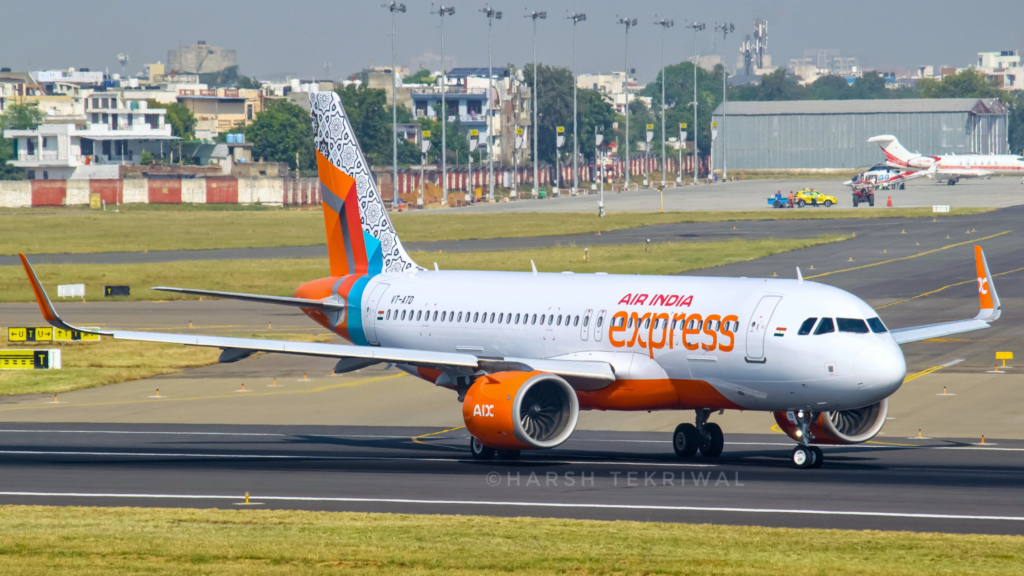
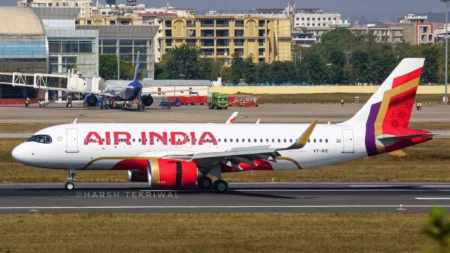
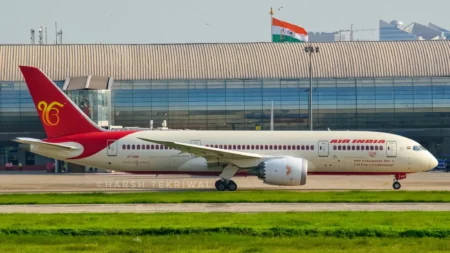
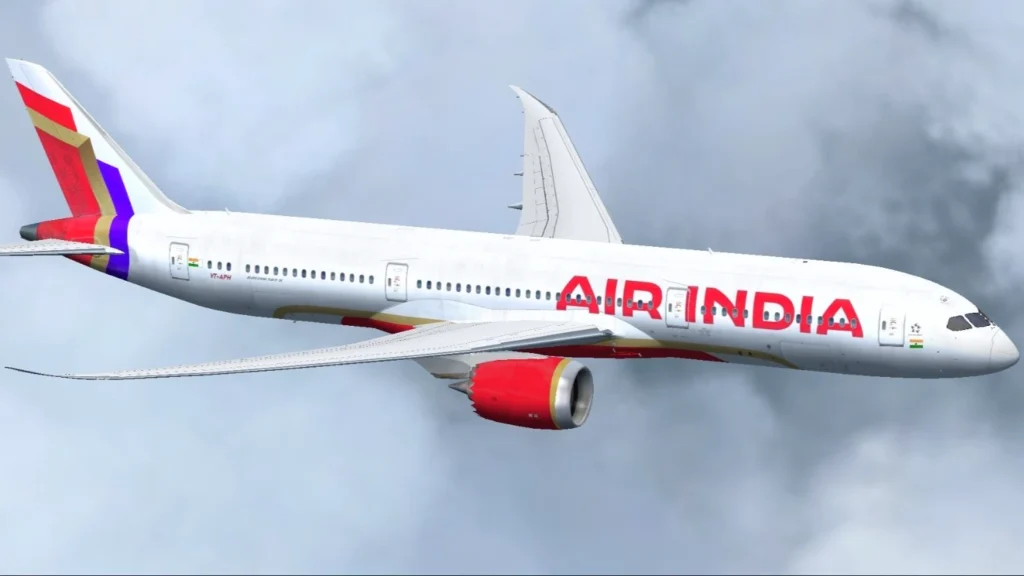
MUMBAI- Tata Group-owned Air India (AI) non-stop flight AI 187 from Delhi’s Indira Gandhi International Airport (DEL) to Toronto Pearson International Airport (YYZ) was diverted to Vienna (VIE) on August 11, 2026.
The reason for the diversion was the use of the wrong aircraft by Air India. Air India earlier used to operate the Delhi-Toronto flight with a fuel stopover at Vienna Airport due to airspace closure and restrictions. However, it made it non-stop from August 1, 2026, after taking delivery of two new 787-9s. Let us explain this in detail.
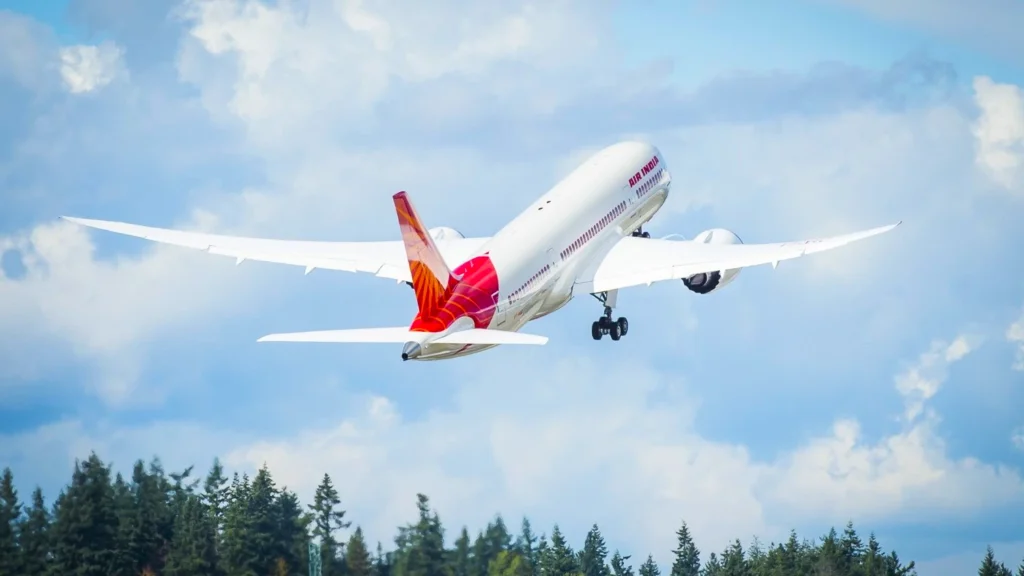
Air India Toronto Flight Diverted, Here’s Why
According to FlightRadar24 data, Air India flight AI187 took off from Delhi at 2:22 AM local time for a 16-hour journey.
But because of the wrong aircraft model deployed on the route, the Air India pilots had to make a stopover in Vienna and landed safely at 7:24 AM local time.
After remaining on the ground for roughly two hours, the flight took off from Vienna at 9:18 AM and landed safely in Toronto at 11:40 AM local time.
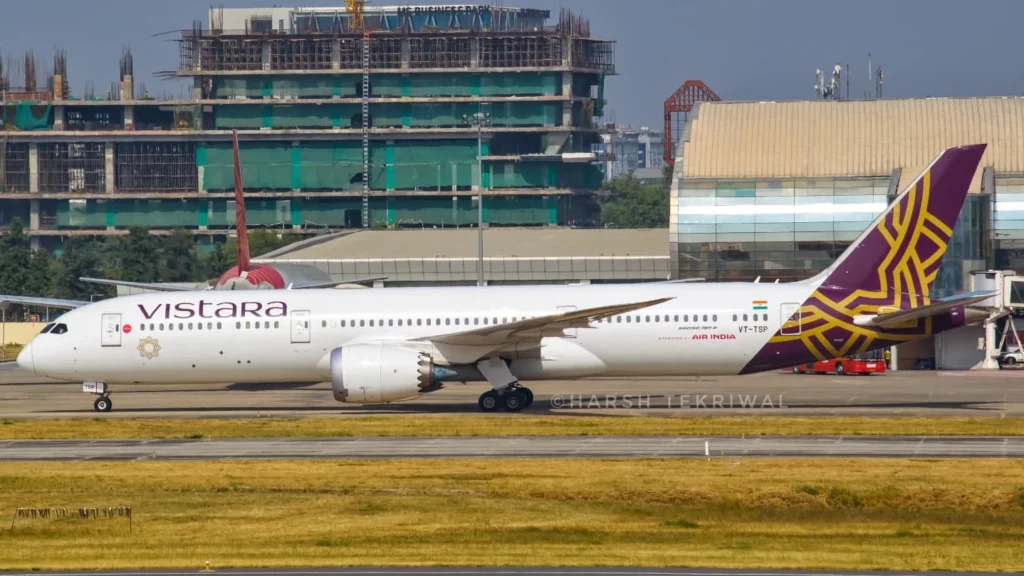
So what do we mean by the wrong aircraft model? To understand this, let us understand Air India’s new Boeing 787-9 Dreamliner fleet.
Note: In total, Air India has nine 787-9s; out of those, 6 were previously operated by Vistara Airlines.
Air India currently operates three new Boeing 787-9 Dreamliners registered as follows:
- VT-AWA (Delivered in Jan 2026)
- VT-AWB (Delivered in May 2026)
- VT-AWC (Delivered in July 2026)
Thanks to Aviation All for flagging this:
Air India’s first 787-9 was delivered in Jan 2026. FAA recently allowed Boeing to deliver the Boeing 787-9 and -10 variants with an increased maximum takeoff weight (iMTOW).
Now, what is iMTOW?
Boeing 787s iMTOW Approval
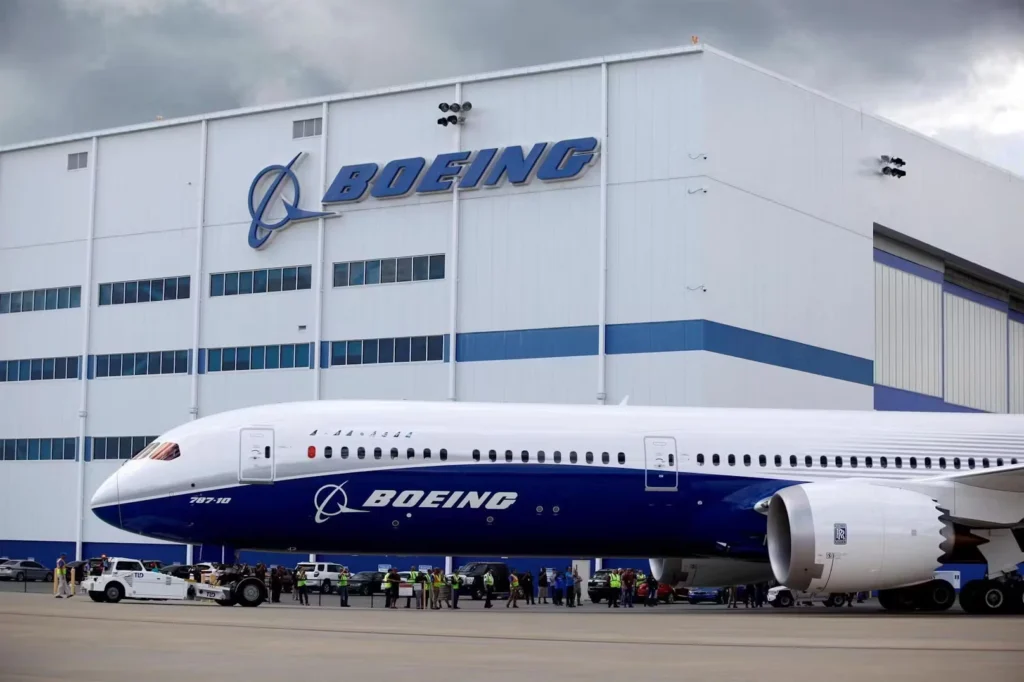
Boeing has received U.S. Federal Aviation Administration (FAA) certification for an increased maximum takeoff weight (iMTOW) on the Boeing 787-9 and 787-10 Dreamliner. The approval gives airline customers greater flexibility to carry more payload or operate longer routes without compromising fuel efficiency.
The first aircraft equipped with the new capability are now moving through delivery activities, with Air New Zealand (NZ) set to become one of the first operators of the upgraded Boeing 787-9.
The enhancement supports airlines seeking better network performance while maintaining the aircraft’s existing operating efficiency.
FAA Approval Expands Boeing 787 Operational Flexibility
The FAA’s certification marks a significant milestone for the Boeing 787 Dreamliner program. The increased maximum takeoff weight provides airlines with the option to improve payload capacity, extend route range, or balance both based on their operational requirements.
According to Boeing, the initiative was developed after airlines requested greater flexibility from the 787 family. Some operators wanted the Boeing 787-10 to fly longer sectors, while others sought additional payload capability on the Boeing 787-9, even if it meant trading some range.
John Murphy, Boeing’s 787 Chief Project Engineer, said customer feedback directly shaped the program. Boeing responded by developing a solution that meets multiple operational needs while preserving the aircraft’s efficiency.
The first aircraft built with the certified capability are currently progressing through final ticketing and delivery processes before entering commercial service.
Air New Zealand Among First Airlines to Receive Upgraded Aircraft
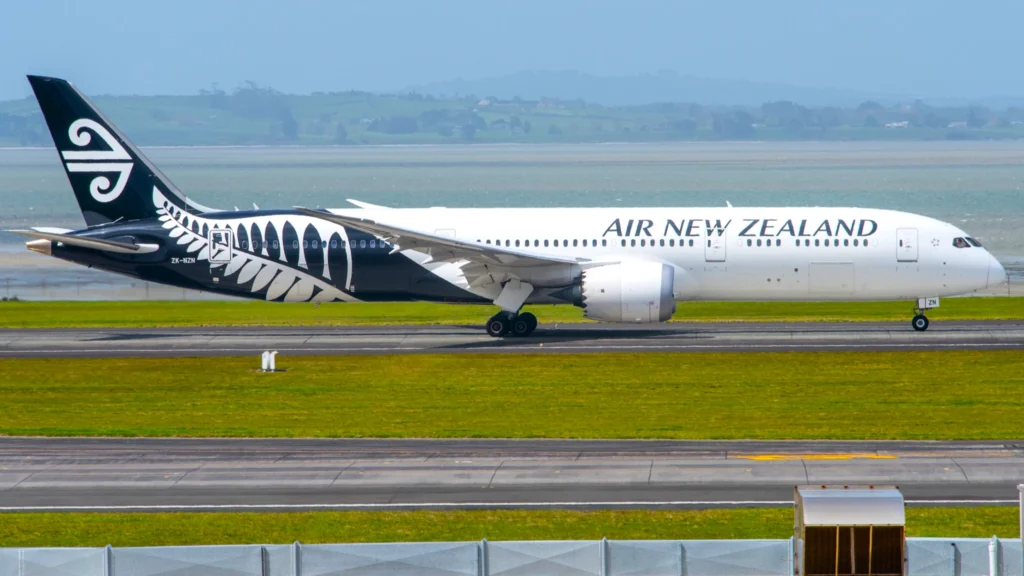
Air New Zealand (NZ), the launch customer for the Boeing 787-9, will be one of the earliest airlines to introduce the enhanced aircraft into its fleet.
The airline confirmed that its first Boeing 787-9 with the increased maximum takeoff weight has completed final assembly and is preparing for inspections and flight testing before delivery.
The new aircraft rolled out from Boeing South Carolina following final assembly and will undergo standard certification flight testing before entering service.
Airlines Can Choose When to Activate the Capability
Boeing confirmed that every Boeing 787-9 and Boeing 787-10 assembled since December 2025 is structurally capable of operating at the higher certified weight.
However, airlines are not required to activate the capability immediately. Operators can choose to certify the aircraft at the increased weight during delivery or decide to activate the option later.
Note: Air India opted for it and received two 787-9s with iMTOW.
This approach allows airlines to align the aircraft’s certified operating weight with their network strategies, airport operating costs, and route economics. Since airport charges in many locations are based on certified maximum takeoff weight, carriers have the flexibility to optimize costs while preserving future growth options.

Performance Improvements for Both Dreamliner Variants
The increased maximum takeoff weight delivers measurable performance gains for both aircraft variants.
For the Boeing 787-9, the approximately 10,000-pound, or 4,540-kilogram, increase allows airlines to carry about three additional metric tons of payload or extend range by more than 300 nautical miles, approximately 560 kilometers.
The Boeing 787-10 receives an even larger improvement. Its roughly 14,000-pound, or 6,350-kilogram, increase enables operators to transport about five additional metric tons of payload or fly more than 400 additional nautical miles, approximately 740 kilometers.
Despite these improvements, Boeing stated that the Dreamliner family continues to deliver up to 25 percent better fuel efficiency than the aircraft it typically replaces.
Supporting Future Route Development
Boeing believes the enhanced capability will allow airlines to explore new market opportunities while improving the economics of existing services.
Darren Hulst, Boeing Vice President of Commercial Marketing, noted that since entering commercial service in 2011, the 787 Dreamliner family has enabled more than 530 new nonstop routes that were previously not commercially viable.
The increased maximum takeoff weight expands those possibilities further by allowing airlines to launch longer nonstop flights, serve underserved destinations, and improve payload performance on existing routes.
For airlines operating long haul and ultra long haul networks, the additional flexibility can improve cargo capacity, passenger loads, and overall route profitability without introducing a new aircraft type.
Certification Backed by Extensive Engineering
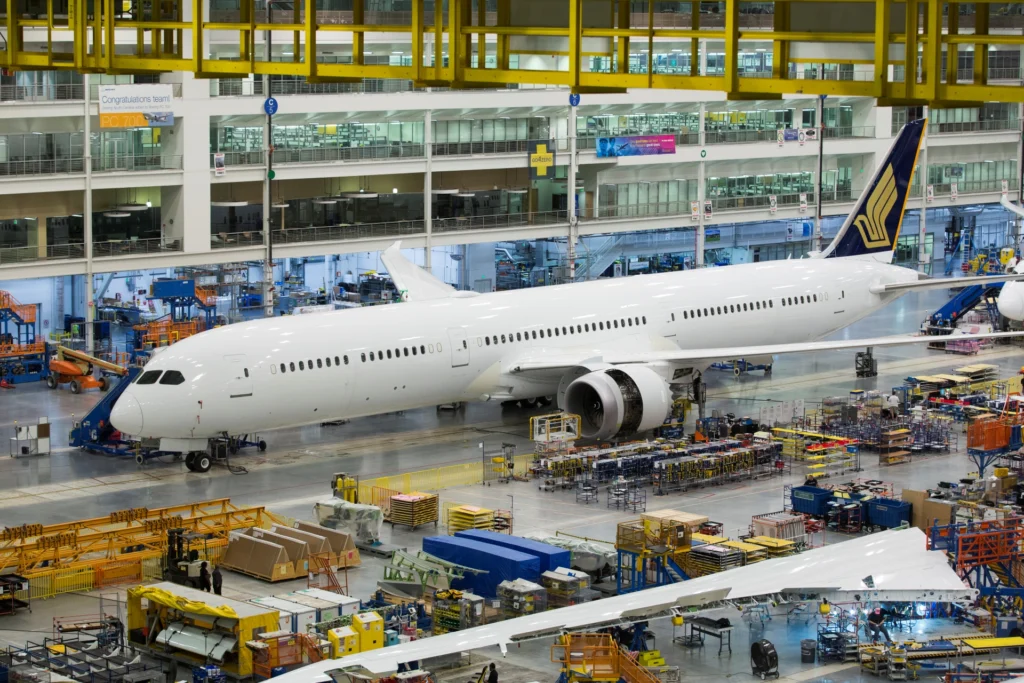
Boeing said the certification follows years of engineering analysis, testing, and close collaboration with the FAA and international aviation regulators.
Lisa Fahl, Vice President of 787 Engineering, explained that engineers conducted extensive structural evaluations, performance analysis, and systems validation to ensure safe operation at the higher certified weight.
The approval represents another major development for the Dreamliner family, which has now surpassed 1,250 aircraft deliveries worldwide since entering service approximately 15 years ago.
Scott Stocker, Boeing’s Vice President and General Manager of the 787 Program, said the certification demonstrates Boeing’s continued commitment to improving the Dreamliner platform through disciplined engineering and close partnerships with airline customers.
Air India Flight Diversion
But a new question arises: why did Air India deploy a 787-9 without iMTOW certification on a nonstop route?
To understand this, we checked the flight data of other 787-9s flying on the route and found out the reason.
On August 11, 2026, Air India deployed VT-AWB on the Delhi-Frankfurt flight AI2029 route instead of the Delhi-Toronto route.
But this is not the first time that Air India has deployed the wrong aircraft model.
On March 19, 2026, Air India (AI) Boeing 777-200LR operating Flight AI185 from Delhi (DEL) to Vancouver (YVR) was forced to return to Delhi after flying for more than four hours because the aircraft lacked regulatory approval to operate into Canada.
The airline had clearance from Canadian authorities to use only its Boeing 777-300ER fleet on flights to Canada, but the 777-200LR was mistakenly assigned to the route. The error was discovered when the aircraft was near Kunming in Chinese airspace, prompting an immediate turnaround.
Bottom Line
Air India (AI) flight AI187 from Delhi (DEL) to Toronto (YYZ) was diverted to Vienna (VIE) on August 11, 2026, after the airline deployed a Boeing 787-9 that lacked the increased Maximum Takeoff Weight (iMTOW) certification needed for the newly launched nonstop service.
Only VT-AWB and VT-AWC were delivered with iMTOW certification, while the first aircraft, VT-AWA, was delivered before the FAA approved the higher-weight variant.
Stay tuned with us. Further, follow us on social media for the latest updates.
Join us on Telegram Group for the Latest Aviation Updates. Subsequently, follow us on Google News