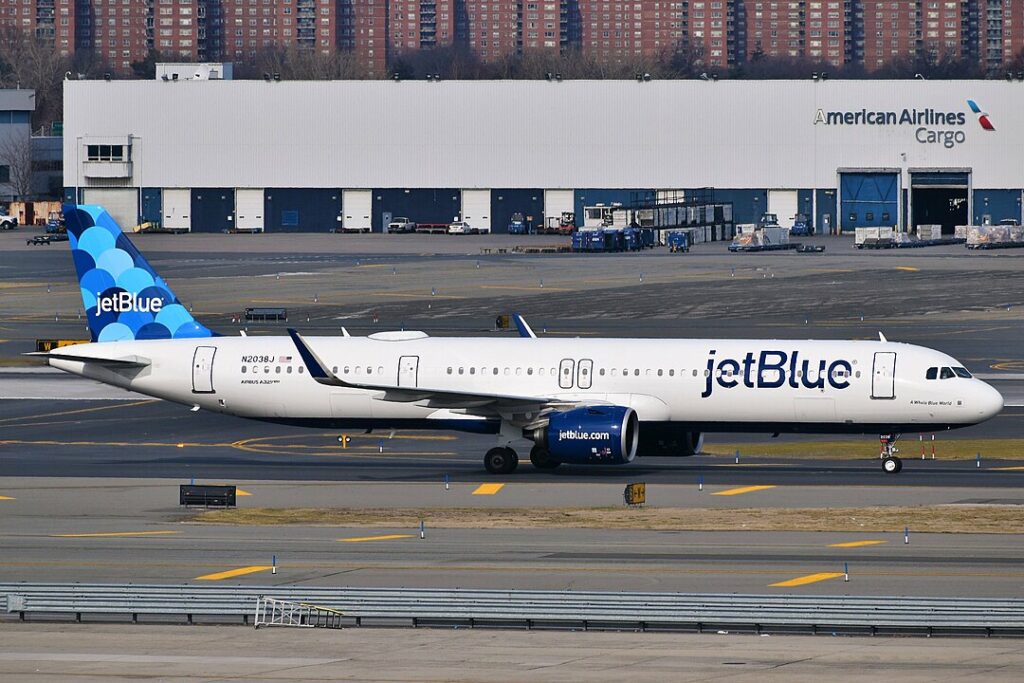
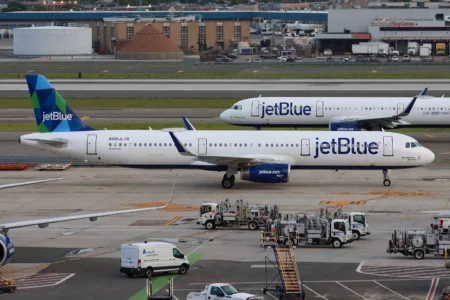
BOSTON- JetBlue Airways (B6) is reportedly preparing to add 12 BlueFirst seats to its Airbus A320, creating three rows of first class in a 2-2 layout. The airline is expected to reveal the product officially on September 1.
The leaked seat map keeps the aircraft at 162 seats while reducing the forward EvenMore cabin from 30 seats to 18. Boston Logan International Airport (BOS) and New York John F. Kennedy International Airport (JFK) are among the key markets for JetBlue’s premium strategy.

JetBlue A320 Set for New BlueFirst Cabin
Aviation industry source JonNYC reports that JetBlue’s new Airbus A320 configuration will feature three rows of BlueFirst seats, giving the aircraft 12 first class seats. The configuration has reportedly been identified as 3R0.
The reported layout uses a 2-2 arrangement in the forward cabin. The change would give JetBlue a dedicated domestic first class product while keeping the aircraft’s total capacity unchanged at 162 seats.
The leaked seat map indicates the following configuration:
- 12 BlueFirst seats
- 18 EvenMore seats
- 12 exit-row extra-legroom seats
- 120 standard economy seats
JetBlue’s existing 162-seat A320 has 30 full EvenMore seats across five forward rows, followed by 12 separately sold extra-legroom seats at the exit rows and 120 standard economy seats.
Under the new layout, JetBlue would remove 12 forward EvenMore seats and replace them with 12 BlueFirst seats, View from the Wing reported.
What Changes for EvenMore Passengers
The reported configuration does not increase the overall number of premium or extra-legroom seats. Instead, it changes the mix of products available at the front of the aircraft.
The current aircraft has 30 forward EvenMore seats. The reported 3R0 configuration would reduce that number to 18, while adding 12 BlueFirst seats.
This means the aircraft would continue to offer 42 seats across BlueFirst, EvenMore and exit-row extra-legroom products. The main change is that 12 seats would move from the EvenMore category into a higher-priced first class product.
Economy Cabin Could Become Tighter
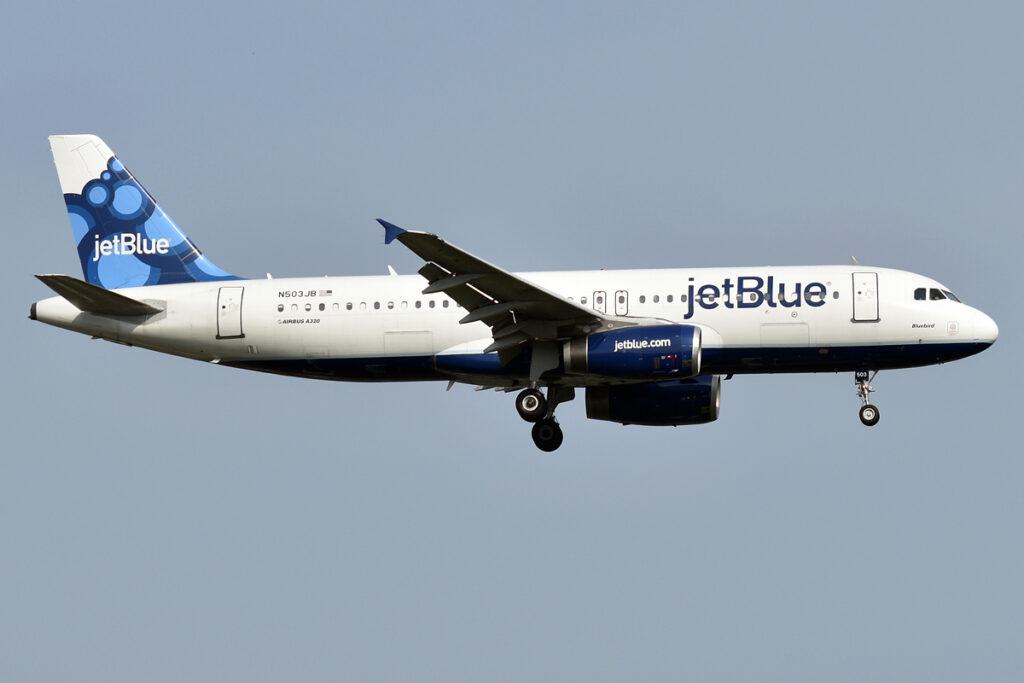
Maintaining 162 seats while adding a physical row at the front creates a significant cabin-layout challenge. The reported map extends to row 28, compared with 27 rows on the current JetBlue A320.
The additional row is possible because BlueFirst uses four seats per row instead of the six-seat configuration used in standard economy rows. However, the extra physical row can reduce the space available elsewhere in the cabin.
JetBlue has not confirmed the final seat pitch for the new configuration. Earlier reporting indicated that standard economy pitch could fall from about 32 inches to approximately 30 inches.
That would represent a notable change for JetBlue, which has historically marketed more generous economy seating as part of its onboard proposition.
For comparison, American Airlines (AA) operates some Airbus A320s with 12 first class seats and 150 total seats. The reported JetBlue configuration would retain 162 seats on the same aircraft type.
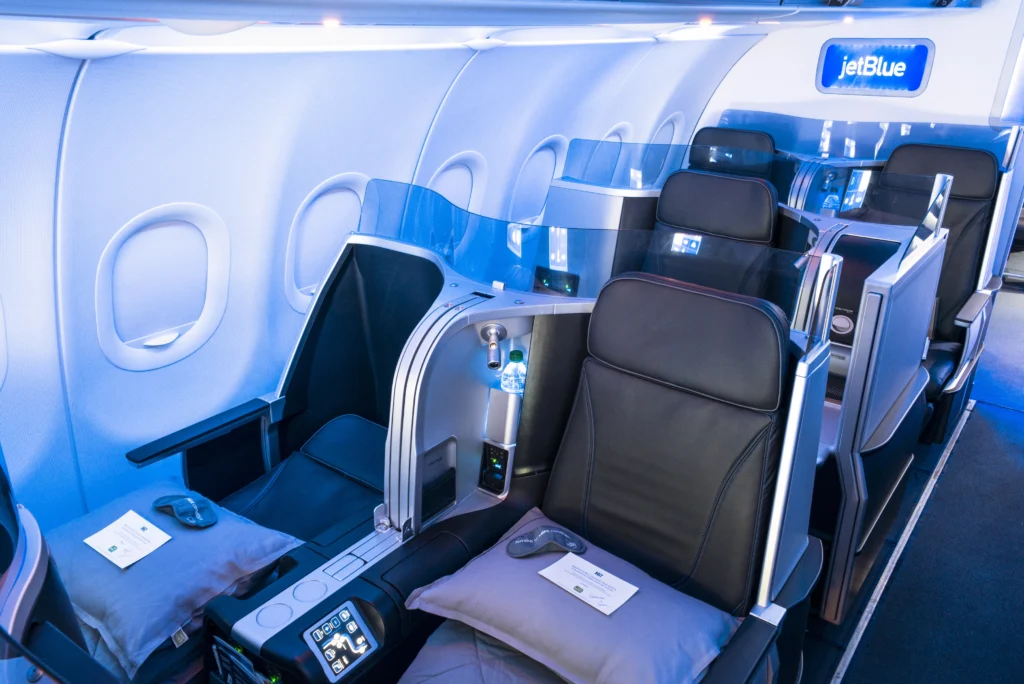
JetBlue Is Reducing Forward EvenMore Capacity
The change also affects a product that JetBlue has positioned as an important part of its premium strategy.
EvenMore launched in January 2025 with benefits that included additional space, dedicated overhead-bin access, earlier boarding, priority security where available, complimentary alcohol and premium snacks in the forward cabin.
JetBlue later separated some mid-cabin and exit-row seats into independently sold extra-legroom options.
The reported A320 configuration would reduce the number of seats receiving the full forward EvenMore package. Mosaic members and other passengers seeking the product could therefore face fewer available seats on aircraft fitted with the new layout.
JetBlue has indicated that its premium products have performed strongly. The airline reported premium RASM growth of about 13% in the second quarter, compared with about 11% for its Main cabin.
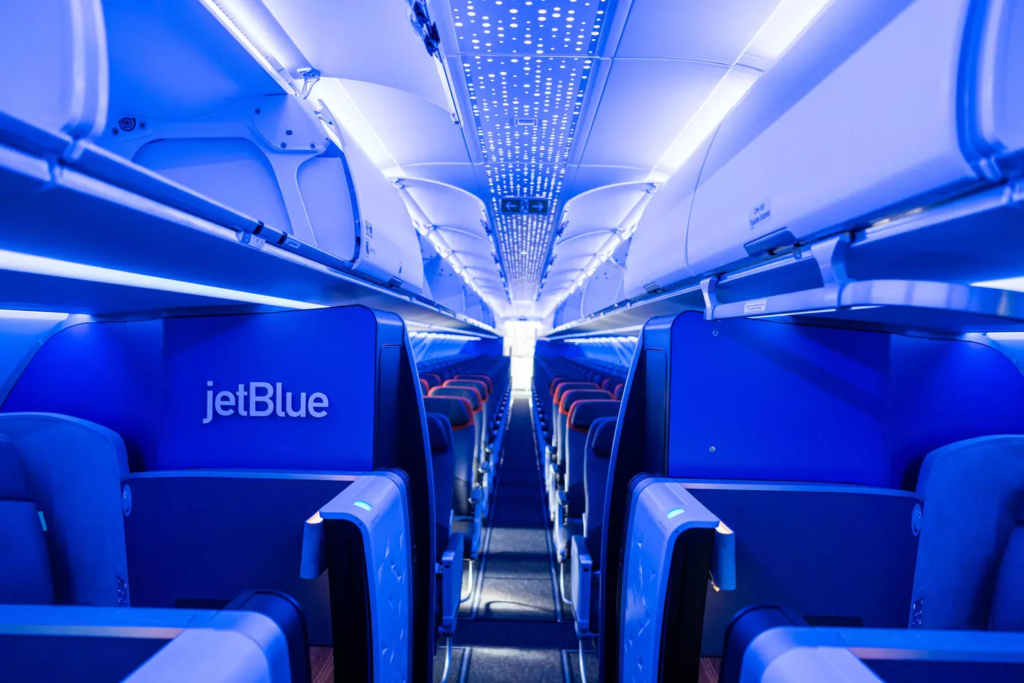
BlueFirst Expands JetBlue’s Premium Strategy
The addition of BlueFirst forms part of JetBlue’s broader JetForward strategy. The airline has been moving toward a larger premium offering as it seeks to improve revenue performance.
JetBlue previously outlined plans for two or three rows of domestic first class and later raised its framework to three or four rows on non-Mint aircraft. The airline has targeted a premium mix of about 27% across its fleet.
The reported three-row A320 configuration sits within that broader plan without increasing total aircraft capacity.
BlueFirst also gives JetBlue another premium product to sell on flights connecting major East Coast markets with leisure destinations. The airline operates a large network touching New York and has a significant presence in Boston.
New York remains particularly important to JetBlue, with roughly half of its flights touching the market. The airline also held about 26% of Boston seat capacity in the period cited in its corporate filings.
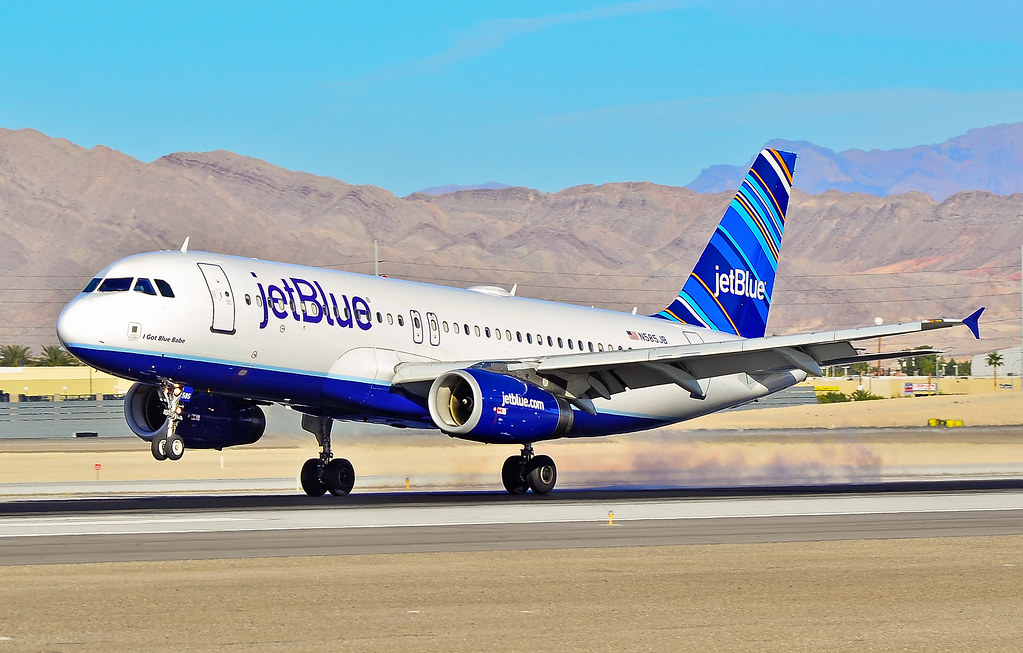
How JetBlue Compares With Other A320 Operators
The reported 12-seat BlueFirst cabin would put JetBlue at the same first class seat count as United Airlines on its A320, but below Delta Air Lines and American Airlines’ newer A320 configurations.
| Airline | Total Seats | First Class | Extra-Legroom | First + Extra-Legroom |
|---|---|---|---|---|
| JetBlue 3R0 | 162 | 12 | 30* | 25.9% |
| Delta A320 | 157 | 16 | 18 | 21.7% |
| United A320 | 150 | 12 | 42 | 36.0% |
| American A320 retrofit | 150 | 16 | 33 | 32.7% |
*JetBlue’s reported 30 seats includes 18 EvenMore seats and 12 exit-row extra-legroom seats.
The comparison shows that JetBlue is not pursuing the highest first class seat count on the A320. Its reported configuration instead maintains a relatively balanced premium cabin while preserving total capacity.
Larger first class cabins can generate more premium revenue when demand is strong, but they also expose airlines to more unsold premium inventory when demand is weak. JetBlue’s reported three-row configuration represents a more measured approach.

BlueFirst Targets Higher-Fare Demand
BlueFirst gives JetBlue another way to capture customers willing to pay more for a premium domestic seat. The product could also complement Mint services by providing a premium domestic segment for passengers connecting to longer international journeys.
JetBlue has said its completed onboard product overhaul could generate about five points of RASM improvement. The airline has identified BlueFirst as one of the largest remaining earnings drivers within its JetForward plan.
However, the reported 12-seat A320 configuration alone will not determine the financial impact of the broader strategy. The airline’s results will depend on pricing, demand, aircraft utilization and the ability to sell premium seats without excessively discounting them.
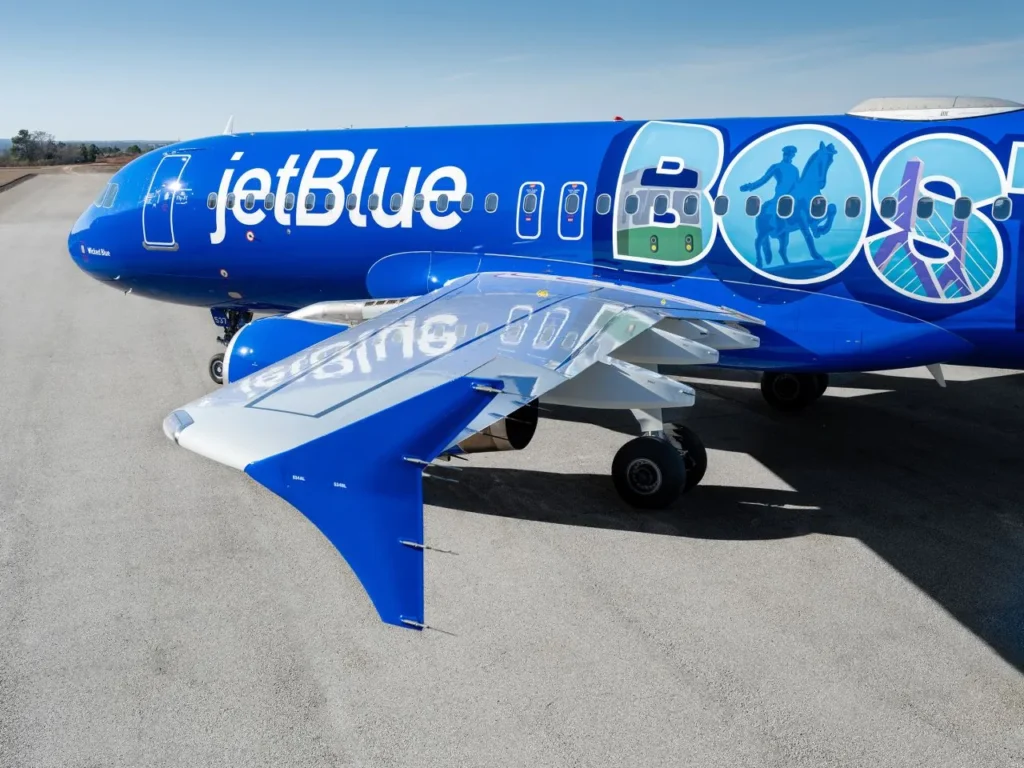
JetBlue Faces Pressure to Improve Financial Performance
The BlueFirst rollout comes as JetBlue continues to face significant financial pressure.
The airline reported a net loss of $602 million for 2025, its sixth consecutive annual net loss. It then reported another $566 million loss during the first half of 2026.
JetBlue’s full-year adjusted operating margin guidance remains between negative 2% and negative 5%. The airline also faces substantial interest costs on approximately $8.5 billion of debt.
The carrier originally expected to retrofit about 25% of its non-Mint fleet during 2026, later reduced that target to about 20%, and subsequently indicated that most of the work would occur in 2027.
The full financial benefit of the onboard product changes is therefore expected to take several years to materialize. JetBlue has indicated that the broader BlueFirst payoff is expected mainly in late 2028 or 2029.
The reported A320 configuration represents one part of that longer-term strategy. It gives JetBlue a new premium product while keeping the aircraft at 162 seats, but it also reduces the number of forward EvenMore seats and could make the economy cabin tighter.
Stay tuned with us. Further, follow us on social media for the latest updates.
Join us on Telegram Group for the Latest Aviation Updates. Subsequently, follow us on Google News