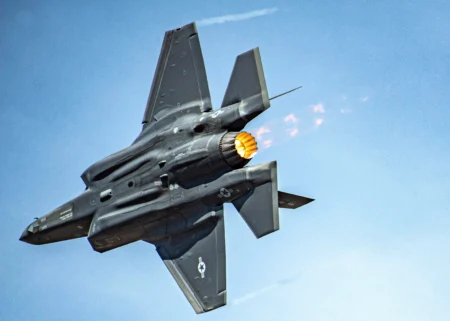
SAN DIEGO– A U.S. Marine Corps F-35B Lightning II stealth fighter crashed near Marine Corps Air Station Miramar in California on Friday after the pilot ejected moments before impact. Military officials confirmed the pilot survived the accident and sustained non-life-threatening injuries.
The crash occurred near Marine Corps Air Station Miramar, located in San Diego, where emergency responders quickly secured the area.
The incident involved the short takeoff and vertical landing (STOVL) variant of the Lockheed Martin F-35, one of the most advanced fighter aircraft in U.S. military service.
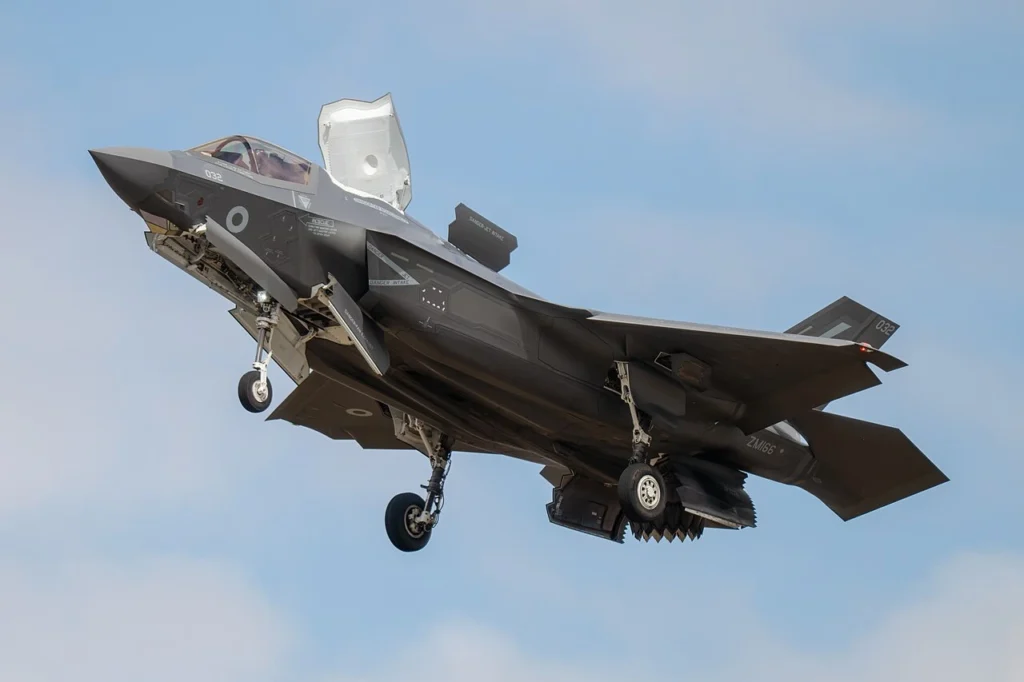
F-35B Crash Near Miramar
The U.S. Marine Corps said the pilot safely ejected before the aircraft struck the ground and was transported to a local medical facility in stable condition for evaluation and treatment. Authorities confirmed the injuries were not considered life-threatening.
Television aerial footage showed thick black smoke rising from the crash site in a dirt field near the air base. Firefighters and military personnel responded immediately, using fire hoses and flame retardant to extinguish the fire while securing the wreckage.
A vegetation fire also broke out following the crash, prompting assistance from the San Diego Fire Department. Emergency crews remained at the scene while military officials began their initial response.
Witness Describes Impact
A local worker who witnessed the accident said two military aircraft were approaching the runway together when one landed normally.
The second aircraft reportedly slowed dramatically at low altitude, appearing to hover before the pilot ejected at approximately 100 feet above the ground.
According to the eyewitness, the parachute deployed successfully just before the aircraft impacted the runway area and exploded. The crash produced a large fireball and thick smoke that was visible from nearby roads and industrial facilities.
The Marine Corps has not released details regarding the cause of the accident. An investigation is expected to determine the sequence of events that led to the loss of the aircraft.
F-35 Program
The aircraft involved was an F-35B Lightning II, the variant specifically designed for short takeoffs and vertical landings. The aircraft is operated by the U.S. Marine Corps and is capable of conducting missions from amphibious assault ships and austere airfields where conventional runways are unavailable.
According to the U.S. Government Accountability Office, the U.S. Marine Corps, Navy, and Air Force collectively operate more than 630 F-35 aircraft.
The F-35B carries an estimated unit cost of approximately $109 million, while the overall F-35 program is projected to exceed $2 trillion over its lifetime, including future procurement and decades of operational support.
The Marine Corps classified the accident as a “Class A mishap,” the military’s highest accident category. Such incidents are designated when an aircraft is destroyed, damages exceed $2 million, or a service member is killed.
Marine Corps Air Station Miramar, once home to the Navy’s famous “Top Gun” fighter training program before its relocation to Nevada in 1996, remains one of the military’s most important aviation bases.
Investigators are expected to examine flight data, maintenance records, and operational conditions to determine what caused the latest F-35B crash.
Stay tuned with us. Further, follow us on social media for the latest updates.
Join us on Telegram Group for the Latest Aviation Updates. Subsequently, follow us on Google News