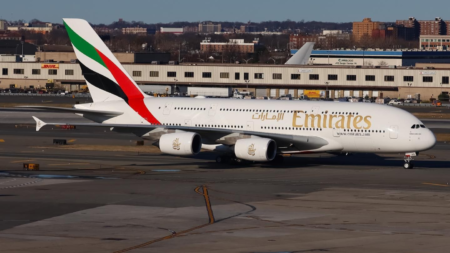
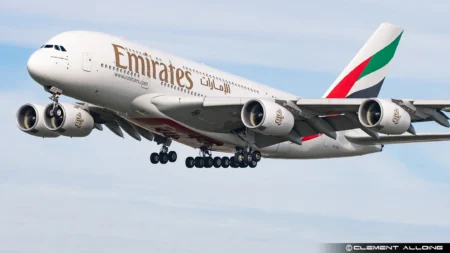
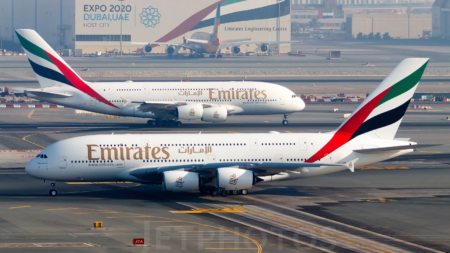
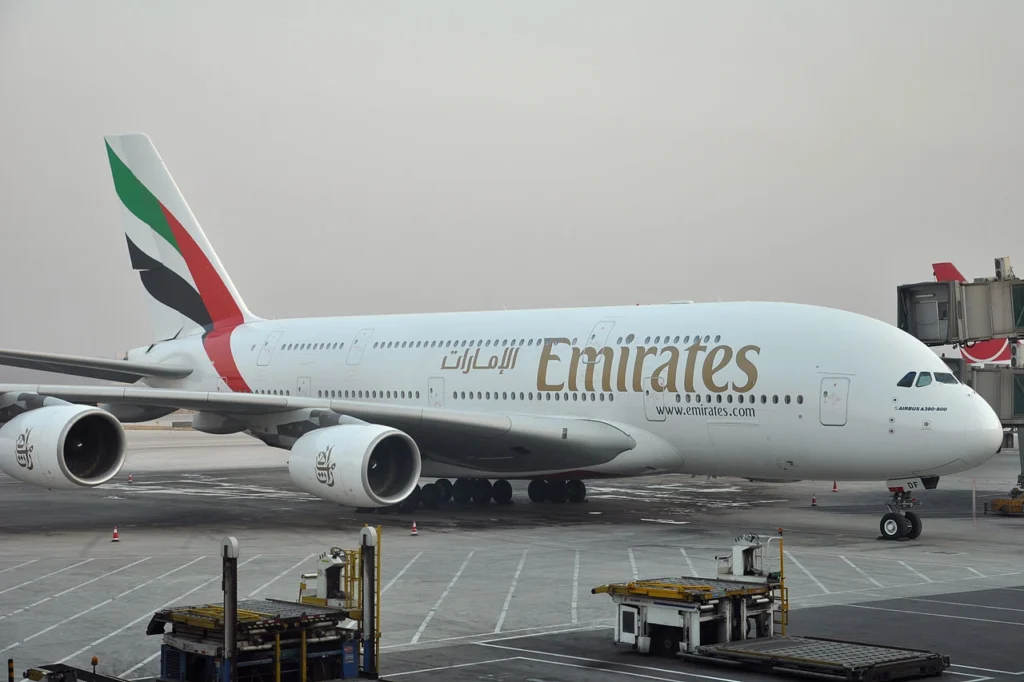
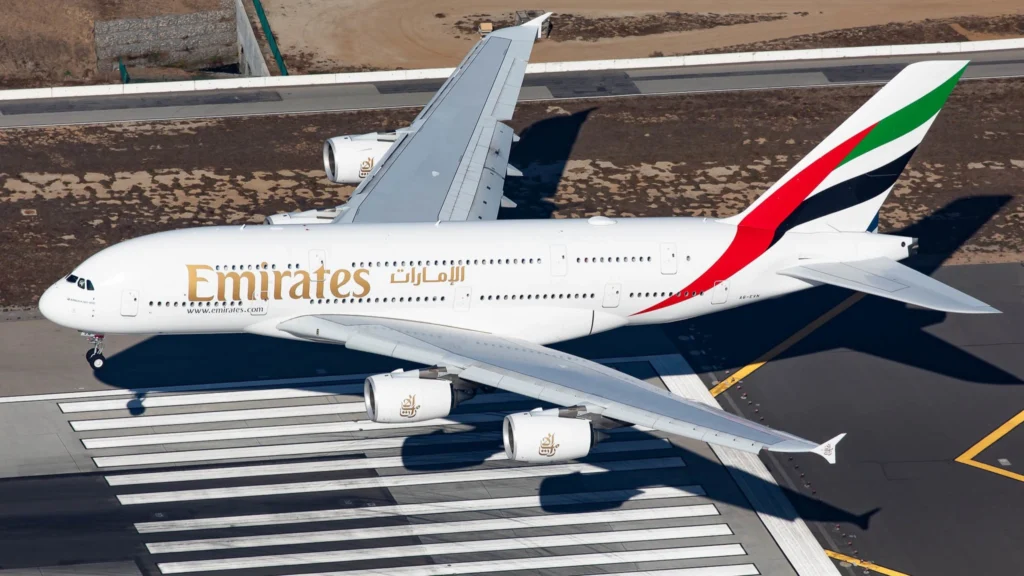
DUBAI- Emirates (EK), the world’s largest Airbus A380 operator, continues to deploy its oldest superjumbo on major international routes from Dubai International Airport (DXB). Despite being over two decades old, aircraft A6-EDF remains an active part of the airline’s long-haul network.
During the first ten days of August, the Airbus A380 served key destinations including London Gatwick Airport (LGW), London Heathrow Airport (LHR), Manchester Airport (MAN), Munich Airport (MUC), Seoul Incheon International Airport (ICN), and Bangkok Suvarnabhumi Airport (BKK), highlighting Emirates’ continued reliance on its flagship aircraft.
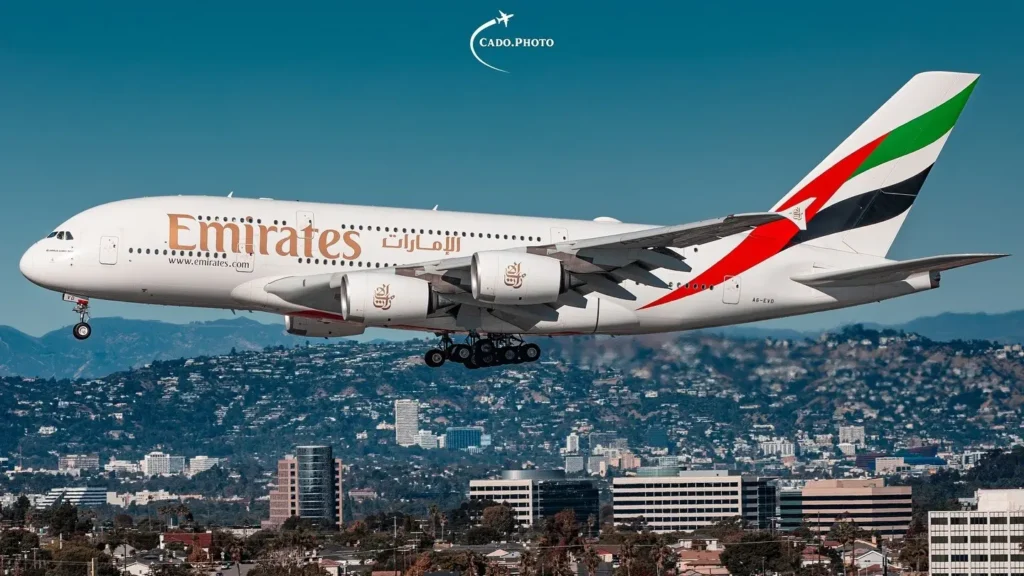
Emirates’ Oldest Airbus A380 Continues Intensive Operations
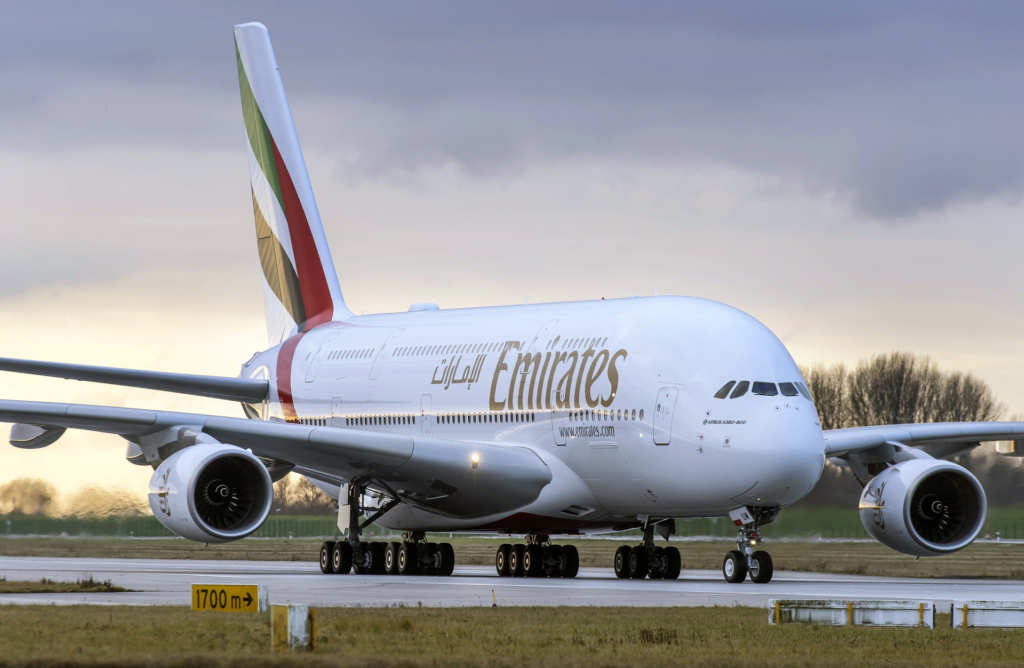
Emirates has built the world’s largest Airbus A380 fleet around its global hub at Dubai International Airport (DXB). The airline currently has 117 Airbus A380 aircraft registered in its fleet, with an average fleet age of approximately 11.6 years, according to ch-aviation.
The oldest aircraft in the fleet carries registration A6-EDF. At 20.5 years old, it was the seventh Airbus A380 ever produced. Although the aircraft is among the oldest flying superjumbos, Emirates continues to assign it to several of its busiest international routes.
The aircraft demonstrates how Emirates has successfully extended the operational life of its flagship fleet through maintenance, refurbishment, and strategic deployment across high-demand markets, Simple Flying reported.
UK Routes Dominate Early August Schedule
Flight tracking data from Flightradar24 shows that A6-EDF completed several long-haul rotations between August 1 and August 10, with the United Kingdom emerging as its primary destination.
The aircraft began the month with a round-trip service between Dubai (DXB) and London Gatwick (LGW) on August 1.
On August 2, it switched airports within the UK by operating to London Heathrow (LHR), one of Emirates’ busiest destinations worldwide.
The aircraft later returned to London Gatwick (LGW) on August 5 and again on August 9 before completing another UK rotation to Manchester (MAN) on August 10.
These operations underline Emirates’ continued use of the Airbus A380 on routes where passenger demand remains consistently strong.
During 2026, Emirates has also accelerated the installation of Starlink internet connectivity across its Airbus A380 fleet. The airline has stated that additional aircraft will receive the upgrade throughout the year, allowing passengers to stream content, browse the internet, work online, and play games during their journey.
European and Asian Destinations Remain Key Markets
The United Kingdom was not the aircraft’s only European destination during the period.
On August 3, A6-EDF completed a round trip between Dubai (DXB) and Munich Airport (MUC) in Germany. Each sector lasted between six and seven hours, making it one of the shorter European services operated by the aircraft.
Following its Munich rotation, the aircraft headed east to Seoul Incheon International Airport (ICN) on August 4.
The outbound journey to South Korea lasted approximately eight hours, while the overnight return flight to Dubai required around nine hours, making it the aircraft’s longest mission during the first ten days of August.
Thailand also featured prominently in its schedule.
A6-EDF completed two separate round trips between Dubai (DXB) and Bangkok Suvarnabhumi Airport (BKK). The first rotation departed on August 7 and returned on August 8. The second round trip took place on August 9.
Each Bangkok sector lasted roughly six hours, demonstrating the flexibility of the Airbus A380 across both medium and long-haul international routes.
During the August 1 to August 10 period, the aircraft served:
- 6 international routes
- 7 airports
- More than 20,395 network miles
The schedule reflects Emirates’ balanced deployment strategy across Europe and Asia using its largest aircraft.
History and Service Record of A6-EDF
Emirates placed its order for A6-EDF on November 4, 2001, during the early development of the Airbus A380 program.
The aircraft completed its first flight on February 19, 2006, before being delivered to Emirates on December 11, 2009.
As of May 31, 2026, the aircraft had accumulated:
- 45,892 flight hours
- 7,539 flight cycles
Its current minimum retirement date is January 2032, indicating that Emirates expects the aircraft to remain in commercial service for several more years.
According to Planespotters.net, A6-EDF spent an extended period in storage in Dubai between 2020 and 2025. That pause in operations contributed to its comparatively lower flight hours despite its age.
Cabin Configuration Remains Three-Class Layout
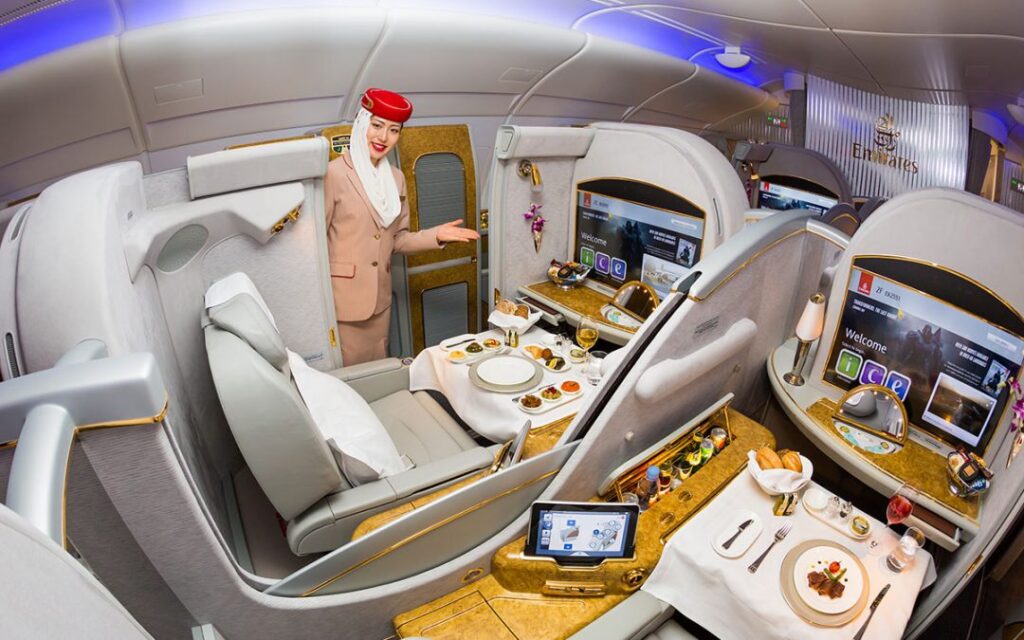
Unlike several newer Emirates Airbus A380 aircraft that have received the airline’s Premium Economy cabin, A6-EDF continues to operate in its original three-class configuration.
The aircraft accommodates 517 passengers, divided as follows:
- First Class: 14 seats
- Business Class: 76 seats
- Economy Class: 427 seats
This means 90 passengers, or around 16 percent of total capacity, travel in premium cabins.
Although it has not yet received Emirates’ latest cabin upgrades, the aircraft continues to support the airline’s high-capacity international network while offering its signature First Class and Business Class products.
With retirement not expected until at least 2032, A6-EDF remains an important asset within Emirates’ Airbus A380 fleet, continuing to connect Dubai with major cities across Europe and Asia.
Stay tuned with us. Further, follow us on social media for the latest updates.
Join us on Telegram Group for the Latest Aviation Updates. Subsequently, follow us on Google News